


Introduction: More Than a House
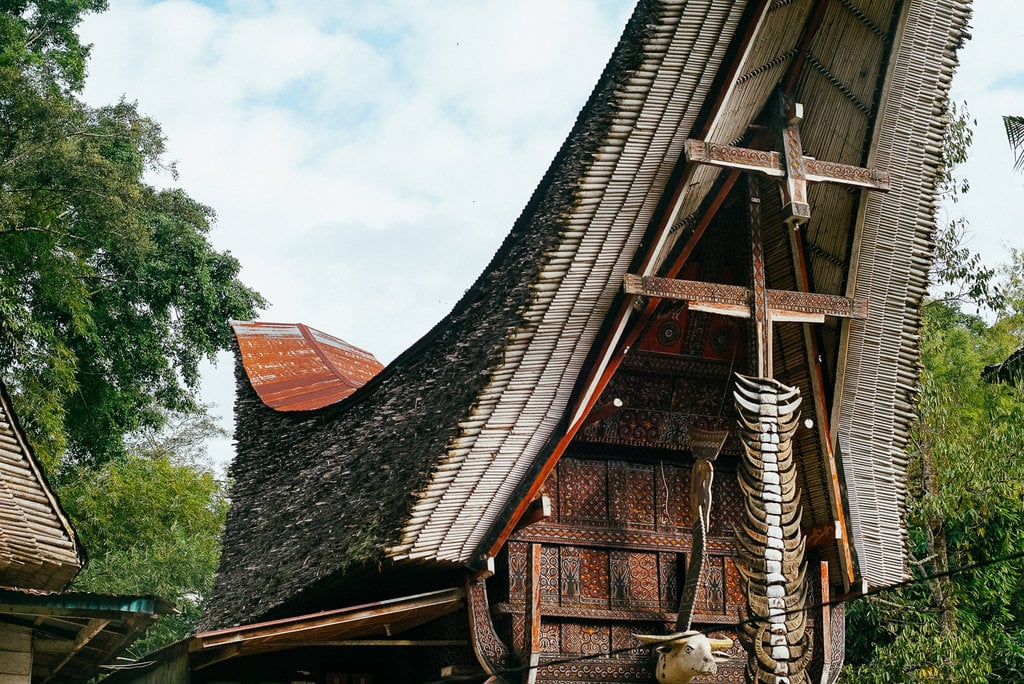
Nestled in the mist-kissed highlands of South Sulawesi, the Tongkonan is no ordinary dwelling. It breathes. It remembers. It speaks in the language of wood and symbol, echoing the spirit of the Torajan people who have lived in harmony with their ancestors for centuries. Far more than shelter, the Tongkonan is a sacred compass — pointing its people toward their origins, social values, and collective memory.
To the Torajans, the Tongkonan is not merely built — it is birthed, with ritual and reverence. It embodies continuity, binding generations in a wooden embrace that defies time.
Ancestral Foundations
The origin of the Tongkonan traces back to celestial myth. Torajan oral tradition tells of the first house constructed in heaven by Puang Matua, the creator god, and then brought to earth. From this divine blueprint, every Tongkonan is modeled.
Each structure is not owned by an individual but by a family lineage. Building a Tongkonan is a communal endeavor, a declaration of ancestral loyalty. The very act of raising its stilts and curving its roof is a spiritual reconnection — an invocation of those who have come before. Through this house, the bloodline remains anchored, sanctified, and visible.
Architectural Elegance and Symbolism
With its sweeping, upward-curving roof, the Tongkonan resembles a boat — a nod to the Torajan belief in their seafaring ancestors. But the orientation is terrestrial and spiritual: always facing north, the direction of the gods. The architecture is not aesthetic whimsy but a codified belief system rendered in bamboo, timber, and thatch.
The materials are never chosen arbitrarily. Black ironwood supports the soul of the house, while bamboo, revered for its resilience, crowns the top. No nails are used — only wooden pegs — maintaining a sacred integrity. Every beam speaks in the language of legacy, every post whispers of past generations.
Symbolic Carvings and Colors
To approach a Tongkonan is to step into a visual scripture. Its facades are adorned with elaborate carvings: spirals, buffalo heads, rosettes, and abstract patterns that are deeply allegorical. These aren’t decorative flourishes; they are encoded messages.
The recurring motif of the pa’tedong, or stylized buffalo, symbolizes strength, sacrifice, and prosperity. Spirals represent the eternal cycle of life and death. Interlocked squares embody community and interconnectedness.
Color is equally deliberate. Black symbolizes death and the afterlife. Red speaks of life and blood. Yellow is the divine, associated with blessings from the gods. White, purity and spirit. Together, they form a cosmic palette — painting the metaphysical order of the universe directly onto the walls.
The Role of Tongkonan in Social Hierarchy
Not all Tongkonan are created equal. The house reflects — and enforces — social stratification. There are three classifications: Tongkonan layuk (noble), Tongkonan pekamberan (commoner), and Tongkonan batu (formerly slave class). Each comes with its own privileges, responsibilities, and ceremonial roles.
A noble’s Tongkonan may tower higher, its carvings more elaborate, its ceremonies grander. The house becomes a status symbol, a monument of inherited authority. Even spatial arrangement within the village mirrors social standing, with higher-ranked families positioned in elevated terrains.
Through architecture, the social order is etched in wood — not merely to be seen, but to be felt and obeyed.
Ceremonial Heartbeat: Life, Death, and Afterlife
A Tongkonan is the axis around which life turns. It witnesses birth rituals, marriage ceremonies, and above all — death rites. Among the Toraja, death is not an end but a prolonged passage. The deceased may reside within the Tongkonan for months, even years, as their soul is prepared for the afterlife.
Buffalo sacrifices are conducted at the Tongkonan’s front. These are not mere traditions but spiritual transactions — feeding the soul, honoring the ancestors, reaffirming social bonds. The house becomes a conduit, a portal through which the living and the dead continue to commune.
If you’re curious to witness these profound traditions firsthand or plan a journey into the cultural heart of Sulawesi, Toraja Journey offers curated experiences that immerse you in the soul of Toraja life. From traditional rituals to scenic highland treks, it’s a gateway into stories etched in wood, stone, and spirit.
Each ceremony reinforces the Tongkonan’s role not just as a stage for life, but as a character in the life of the family itself.
Preservation Amidst Modernity
Tongkonan today stand at a crossroads. Urban sprawl, economic migration, and the spread of global religions have tested the continuity of this ancient tradition. Some families, seeking modern convenience, abandon their ancestral homes for concrete boxes.
Yet many return — during rituals, funerals, harvest celebrations — drawn by a primal chord only the Tongkonan can strike. Efforts by local leaders and cultural preservationists are bearing fruit. Tourism, too, has rekindled appreciation, though it walks a tightrope between admiration and commodification.
Still, the Tongkonan endures — weather-worn but unyielding. It is a monument not to nostalgia, but to resilience. A structure where wood remembers, symbols speak, and the soul of a people endures.